Updated September 2026. Written and reviewed by the Lily Hospice clinical team.
Start now: find the DD-214, ask about VA hospice and Aid and Attendance, and request a pre-need burial eligibility decision. After a death, families may qualify for national cemetery burial, a headstone, a burial flag, a Presidential Memorial Certificate, a burial allowance and survivor benefits. A free veterans service officer can confirm eligibility.
Caring for someone in Oakland, Macomb or Wayne County? A real person answers at Lily Hospice 24 hours a day. You do not need a referral, and calling does not commit you to anything.
When a veteran is dying, families are handed two jobs at once: being present, and paperwork nobody explained. This checklist takes some of the second job off your shoulders: what to do before, how to honor service while there is time, and what comes after, with the metro Detroit offices that help. Eligibility rules depend on the veteran’s service, discharge and circumstances, so treat this page as a map, not a ruling. An accredited veterans service officer (VSO) can tell you what applies, and their help with VA claims is free.
Before: things to start now
1. Find the DD-214
The DD-214 (discharge papers) unlocks almost every benefit on this page. Start with the veteran’s own files and any safe deposit box. If it cannot be found:
- Next of kin (a surviving spouse, parent, child or sibling) can request records from the National Archives’ National Personnel Records Center, online through eVetRecs or by mail or fax with Standard Form 180. The veteran can request his or her own records the same way.
- Veterans with more recent service may be able to download records through the Defense Department’s milConnect site.
- Your county veterans office or the state’s Michigan Veteran Resource Service Center can also help locate discharge documents.
If the papers still are not found by the time of need, VA’s records page says the National Cemetery Scheduling Office will try to locate the records it needs for a burial.
2. Ask about VA health care and hospice
According to VA’s hospice care page, all veterans enrolled in VA health care are eligible for hospice if they meet the clinical need, and there are no copays for hospice whether it is provided by VA or by an organization with a VA contract. VA works with community hospice agencies so care can happen at home. Many veterans on hospice also, or instead, use the Medicare hospice benefit; our page on whether Medicare covers hospice in Michigan explains that side. If the veteran is enrolled with VA, tell both the VA team and the hospice so they can coordinate.
3. Check Aid and Attendance or Housebound
These are monthly amounts added to a VA pension for a veteran or surviving spouse who qualifies. Per VA, Aid and Attendance may apply when someone needs another person’s help with daily activities like bathing, feeding and dressing, must stay in bed much of the time because of illness, or lives in a nursing home because of disability. Housebound applies to someone who spends most of their time at home because of a permanent disability. You cannot receive both. The underlying pension has wartime-service, age or disability, and income and net worth rules; ask a VSO.
4. Look at any service-connected disability claim
If the veteran has a service-connected disability rating, or believes an illness is service-connected, it matters later. Survivor benefits such as Dependency and Indemnity Compensation (DIC) and the burial allowance can depend on whether the death is service-connected, how long a disability was rated totally disabling, or whether a claim was pending at the time of death. Ask a VSO whether anything should be filed now.
5. Consider a pre-need burial eligibility determination
You can apply in advance to find out whether the veteran (and a spouse) is eligible for burial in a VA national cemetery. VA calls this a pre-need determination of eligibility (VA Form 40-10007). It does not reserve a gravesite, but the family is not proving eligibility in the first hours after a death.
6. Know the Veterans Crisis Line
Serious illness can bring up old memories, fear and exhaustion, for the veteran and for caregivers. The Veterans Crisis Line is free, confidential and open 24 hours: dial 988 then press 1, or text 838255. It serves veterans and the people who support them, and you do not need to be enrolled in VA to call.
Honoring service while there is time
- Tell the care team the person served. Military experience can shape how someone feels about pain, control or noise near the end. Knowing helps the team.
- A recognition or pinning ceremony. Many hospices that follow the We Honor Veterans framework offer a simple bedside recognition, often a pin or a certificate and a thank you. If you would like one, ask the Lily team; we can talk through what fits your family. Ask us, and we will plan it around what the veteran and family want.
- Record his or her story. The Library of Congress Veterans History Project collects and preserves veterans’ firsthand accounts. A family member can volunteer to record an interview using the project’s free field kit; the Library’s guidance says an interview must be at least 30 minutes long to be accepted, and release forms are required. If that is too much, recording stories on a phone for the family is worth doing too.
After: benefits for burial and survivors
Burial in a national cemetery
The nearest VA national cemetery to metro Detroit is Great Lakes National Cemetery, 4200 Belford Road, Holly, MI 48442, (248) 328-0386. Burials are scheduled through the National Cemetery Scheduling Office: discharge documents are faxed to 1-866-900-6417 and followed by a call to 1-800-535-1117. The funeral home usually does this. For eligible veterans, VA burial benefits can include a gravesite, opening and closing of the grave, a grave liner, a headstone or marker, a burial flag and a Presidential Memorial Certificate. A spouse and some dependent children may also be eligible for burial there.
Headstone, marker or medallion
VA can provide a government headstone or marker for an eligible veteran’s unmarked grave, including in a private cemetery, or a medallion to attach to a privately purchased headstone for veterans who died on or after November 1, 1990 (VA Form 40-1330 for headstones and markers). VA’s headstone line is 1-800-697-6947.
Burial flag and Presidential Memorial Certificate
A burial flag (VA Form 27-2008) is usually obtained by the funeral director, or from a VA regional office or a post office. A Presidential Memorial Certificate (VA Form 40-0247) honors the veteran’s service; next of kin, family and close friends can request it, and VA accepts multiple requests, so several family members can each have one.
Burial allowance
VA may help pay burial and funeral costs if the veteran was not dishonorably discharged and, for example, died from a service-connected disability, died while receiving VA care, was receiving VA pension or compensation, or had a pending claim that would have been approved. According to VA’s burial allowance page, a surviving spouse listed on the veteran’s VA record may be paid a set amount automatically, without filing. Others apply with VA Form 21P-530EZ; for a death that is not service-connected, the claim generally must be filed within 2 years after burial. Amounts change yearly; ask a VSO for the current figure.
Survivor benefits: DIC and Survivors Pension
- Dependency and Indemnity Compensation (DIC) is a monthly payment that may go to a surviving spouse when the veteran died from a service-connected condition, or had a service-connected disability rated totally disabling for a required period (for example, at least 10 years before death). Marriage and living-together rules also apply.
- Survivors Pension may be available to a surviving spouse who has not remarried, when the veteran had qualifying wartime service and the family’s income and net worth are within limits set by Congress.
Both use VA Form 21P-534EZ. Report the death to VA as soon as possible by calling 1-800-827-1000 and selecting 5, which helps prevent overpayments the family would have to repay.
Michigan and county help
- Michigan Veterans Affairs Agency (MVAA). Its Michigan Veteran Resource Service Center answers at 1-800-MICH-VET (1-800-642-4838), weekdays 8 a.m. to 4:50 p.m., and helps families find discharge documents and a VSO.
- Oakland County Veterans’ Services. Pontiac office, 1200 N. Telegraph Rd., Building 26E, Pontiac, MI 48341, (248) 858-0785; Troy/South Oakland office, 1151 Crooks Rd., Entrance B, Troy, MI 48084, (248) 655-1250. The county says it may provide a burial allowance, marker foundation fee and flag case.
- Macomb County Veteran Services. 21885 Dunham Rd., Suite 3, Clinton Township, MI 48036, (586) 469-5100.
- Wayne County Veterans’ Services. 400 Monroe St., Suite 405 (International Center Building), Detroit, (313) 224-5045, with a satellite office in Garden City. The county lists burial assistance among its services.
- Michigan county veteran burial allowance. Under Michigan law (MCL 35.801), counties pay a modest burial allowance for some honorably discharged wartime veterans and their spouses, subject to residency and estate limits. The application must be made within 2 years of the death. Your county veterans office handles it.
Printable checklist
| What | Who to contact | When |
|---|---|---|
| Find the DD-214 | Family files, county clerk, eVetRecs, MVAA 1-800-642-4838 | Now |
| Ask about VA hospice and coordinate with the hospice | VA care team and the hospice | Now |
| Aid and Attendance or Housebound | County veterans office or accredited VSO | Now |
| Review disability claims that affect survivors | Accredited VSO | Now |
| Pre-need burial eligibility (Form 40-10007) | VA online, or a VSO | Now |
| Pinning or recognition ceremony | Your hospice team | While the veteran is able |
| Record an oral history | Library of Congress Veterans History Project | While the veteran is able |
| Schedule burial at Great Lakes National Cemetery | Funeral home; Scheduling Office 1-800-535-1117 | At time of death |
| Burial flag | Funeral director | Before the service |
| Report the death to VA | VA 1-800-827-1000, select 5 | Days after |
| Headstone, marker or medallion | VA 1-800-697-6947 or funeral home | Weeks after |
| Presidential Memorial Certificate | VA Form 40-0247 | Any time after |
| Burial allowance (VA and county) | VA Form 21P-530EZ; county veterans office | Within 2 years (most cases) |
| DIC or Survivors Pension | VA Form 21P-534EZ, with a VSO | Weeks after |
For the immediate steps at the time of a death at home, see what to do when someone dies at home in Michigan.
When to call the hospice nurse
Paperwork can wait; comfort cannot. If the veteran is on hospice and you see new pain, trouble breathing, agitation, or a change that worries you, call the hospice line, not 911, at any hour. If he or she is not on hospice yet, call the doctor, or call us to talk it through. Here is what happens when you call hospice at night.
How Lily helps veteran families
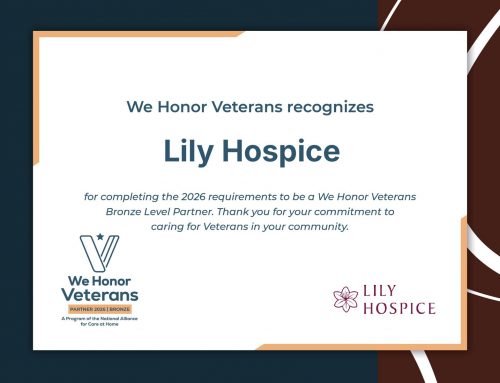
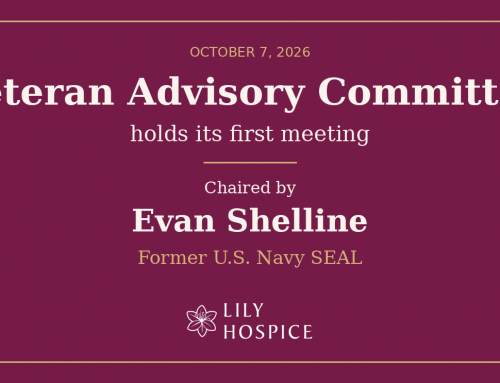
Lily Hospice is a We Honor Veterans Bronze Level partner. We have a Veteran Advisory Committee that guides how we care for veterans, and a Veteran Rapid Response team. Our social worker can help families find the DD-214 and reach an accredited VSO, so the benefits on this page do not fall through the cracks while you are focused on your person. Respite care, chaplains and volunteers are part of it too. Learn more about our veterans program and hospice care for veterans in metro Detroit.
Grief often starts early; see anticipatory grief and our grief support.
Common questions
Does VA pay for hospice?
For enrolled veterans who meet the clinical need, VA says hospice has no copays, whether VA or a contracted community agency provides it. Many veterans use Medicare’s hospice benefit instead.
What if we cannot find the DD-214?
Next of kin can request it from the National Personnel Records Center through eVetRecs or Standard Form 180, and MVAA or a county veterans office can help. For a national cemetery burial, VA’s scheduling office will also try to locate the records.
Is burial at Great Lakes National Cemetery free?
For eligible veterans, VA provides the gravesite, opening and closing, a grave liner, a headstone or marker and a flag. Funeral home charges are separate.
Can we apply for burial eligibility before death?
Yes. A pre-need determination of eligibility (VA Form 40-10007) confirms eligibility in advance. It does not reserve a specific gravesite.
Can more than one family member get a Presidential Memorial Certificate?
Yes. VA accepts multiple requests, so next of kin, family members and close friends can each request one.
Will the surviving spouse keep receiving benefits?
It depends. DIC and Survivors Pension have rules about the cause of death, disability ratings, marriage, wartime service and income. An accredited VSO can review it at no charge.
Can the caregiver call the Veterans Crisis Line?
Yes. It serves veterans and the people who support them. Dial 988 then press 1, or text 838255, any time. You do not need to be enrolled in VA.
Hospice isn’t giving up. It’s showing up. If you are in Oakland, Macomb or Wayne County, call (248) 955-5100. A real person answers, 24 hours a day.